
The Life Behind the Science
Each evening, Matteo Covini chooses a book.
Sometimes he points to the one he wants. Sometimes he studies pictures. One of his parents, David or Caroline, settles beside him to read.
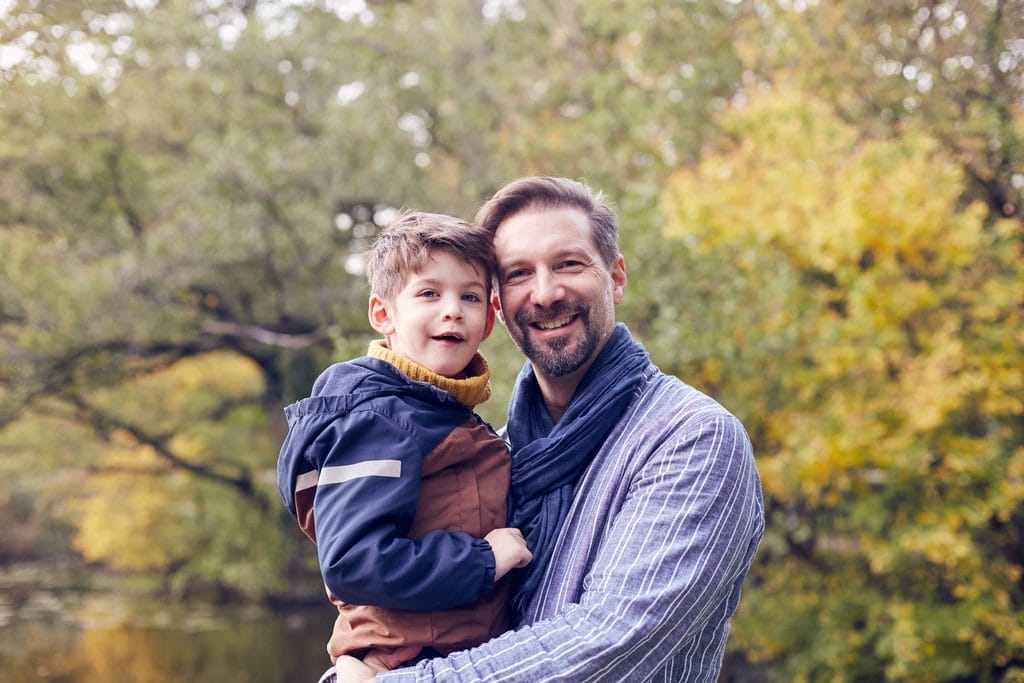
Matteo is eight. He loves Fireman Sam, picture books, and food. He is expressive, particularly through his smile, and has developed his own ways of showing his parents what he wants.
“For me, what I would like people to understand is that despite the disability, Matteo is a human being,” David says. “He is able to enjoy things. He has emotions.”
David, Matteo’s father, is co-founder and president of DupMECP2 and a team lead scientist at Boehringer Ingelheim.
Before research papers, patient registries, and conversations about clinical trials became part of their daily lives, David and Caroline were learning to understand their son – his expressions, his preferences, and the small moments that brought him joy.
When Uncertainty Had a Name
David and Caroline, both scientists, began noticing developmental concerns and frequent infections early in Matteo’s life. When he learned to walk at 28 months, David remembers feeling immense pride.
In 2021, when Matteo was three, David and Caroline received a diagnosis: MECP2 duplication syndrome.
The diagnosis gave their family a name for what they had been trying to understand. It also opened a frightening new set of questions.
“Until then, you want to believe that maybe he has simply been sick and, at some point, he will recover and develop normally,” David says. “Then, at that very moment, you realize: no, they found something.”
The couple had never heard of the condition. Information was difficult to find at geographical level, and the small number of identified families made the path ahead feel isolating. They both began searching, for scientific literature, specialists, researchers, and other families who might understand what they were experiencing.
Their scientific training helped them interpret studies and engage with experts. But it did not make the experience any less personal. “Of course, I’m a scientist,” David says. “But I’m also a father of 2.”

Building a Community
As David and Caroline searched for answers, they found organizations and families in Europe, the United States, and Japan already working to understand MECP2 duplication syndrome.
They founded DupMECP2 in Austria, driven by the urgency they felt as parents. They wanted to help research move forward, collaborate with other organizations, and give families clearer information and stronger connections.
“We don’t have time to waste,” David says. “Every step we can make is bringing us closer to a potential drug.”
Through DupMECP2, David and Caroline have helped translate complex scientific information into accessible resources for families, including articles, newsletters, and multilingual webinars. David also makes his personal phone number publicly available so newly diagnosed families can reach out directly.
“They are lost and they want to know what is going on,” he says. “I’m not here to say, ‘Poor you.’ It’s because I know what it is.”
For a newly diagnosed family, the first need is often not a technical explanation. It is to know that they are not alone.
A Place in the Bigger Picture
For rare diseases, being counted can be a form of progress.
DupMECP2 developed REMEDS, a registry and survey platform for the MECP2 duplication syndrome community. By collecting information from families over time, the platform may help researchers better understand how the condition develops and support planning for future research and clinical studies.
But David sees an equally important human value.
“When families take part, they can feel, ‘Now I am officially part of the community,’” he says.
Hope and Uncertainty
In the years since Matteo’s diagnosis, clinical research programs for MECP2 duplication syndrome have begun to emerge. For David, this progress brings hope, but not certainty.
“It remains a trial,” he says. “There are risks.”
That is why DupMECP2 offers multilingual webinars to help families understand what trial participation may involve, including practical considerations such as hospital visits. For David, advocacy means helping families approach those decisions with clearer information and a community behind them.
For BioDuro and its global partners, David’s story is a reminder of the patients and families whose questions give scientific progress its urgency.
Holding on to the Smiles

David does not describe his family’s experience as simple. There have been hard decisions, painful uncertainty, and moments of grief. But he resists reducing life to its most difficult parts.
“Life can be hard, can be enjoyable, can be bright and wonderful,” he says. “It’s all at the same time.”
That perspective shapes the advice he gives to parents who have just received a rare-disease diagnosis: seek information, ask for help, find other families, and make room for support. But also make room for joy.
“If our kids are able to smile and enjoy some things, take the time to enjoy this as well,” David says. “The other things that are hard – they are every day, they are constant – but keep in mind there are some smiles as well.”
The work of DupMECP2 began with Matteo and with David and Caroline’s belief that no family should have to navigate an ultra-rare diagnosis alone.
And each evening, it returns to something simpler: a book, a parent, a child, and the many ways a family learns to understand one another.
MECP2 duplication syndrome is a rare genetic condition caused by an extra copy of the MECP2 gene, which plays an important role in brain development and function. It can affect learning, movement, and communication, and may involve seizures and recurrent infections. Each person’s experience is different.
To learn more about the condition and the work supporting affected families, visit DupMECP2’s website


